Monday, November 12, 2012

The sun is climbing


The sun is climbing and the evenings are longer and lighter now.The tomatoes are planted, the chard and beetroot has bolted and the quinces are yellowing but so far eluding the birds. We are treading on the coat tails of Summer and already I miss the green fuse that is early Spring. The first short days of the season are fragile. They are early cold and all afternoon sun. But we are grateful for it. Bees are about - they have overwintered on honeycomb but now are about pollen getting again. They are on the pear blossoms and the echium. They nose into half open roses and use the magnolia like a helipad. The first few weeks of Spring are for those, like bees, who live for flowers.

Three years ago we flew to Japan in flower viewing month to chase the cherry blossom north from Tokyo into the mountains. We diligently followed reports in the Japan Times, where a boxed diagram daily charts the tide of flowers rolling across the country. A map spread out on the hotel bed and  a squint at the flower forecast on the evening news, helped plot a journey from Spring into the last days of Winter. So linear is the island of Japan it seems to be possible to move backwards through time and seasons.

On streets, in parks and from train windows we studied the Japanese in full Hanami mode - something deeply arresting in the 
value put on transient beauty by a nation so steeped in work and hardship. That some of the oldest trees are named and venerated almost as saints seemed wonderful to us - their branches propped and roped to prevent injury - blankets spread underneath them. Picnics and parties celebrate the fleeting few days of blossom. The Sakura is a non eating cherry - it bears small blunt fruit that fall to the ground green, so it is for its flower alone that it is prized. As Basho walked and penned his haiku visiting with mountains and rivers there are some in Japan who visit the old trees, calling in on them, spending an afternoon with them, sharing sake - perhaps even a song.

In Melbourne spring is signalled by sudden warm days, days of wind and then a week of cold nights. Just as the wisteria has its heaviest bloom the wind dashes them to the ground. This year the blossom seemed to come early starting with the almond and quince and then moving to the cherries and plums. In a spirit of nostalgia we made bento and took it to the cherry trees in the hills. We may not have walked there or known each tree as a friend but it is a good Spring thing to sit with trees.

Now the flowers are gone and the fruit is set. The pictures above might be from another place or age. At the hairdressers I wonder if we will pick apricots before Christmas. The season is at once just begun and nearly over. The Korean barber tells me that the snow is already falling north of Seoul. Early? I ask him. Five days earlier than last year he says. 

Tuesday, August 21, 2012

Celadon as palimpsest


In the chilly Autumn,
thousands of porcelain pieces
as green as the mountains
appear from the kiln.
                    Lu Guimeng

Strictly speaking celadon is not a good green. It has none of the vivid energy of leaf buds, nor the sombre notes of eucalyptus. It is neither verdantly mossy or bravely bottle green. It sits somewhere between jade and lichen  - on the colour spectrum it leans towards grey and away from yellow. Rather than lifting the heart it speaks to it - a colour for poets and those of an exquisite eye. Made from earth and ash, celadon has an earthy appeal. The green glaze is composed of iron and cinders. An incremental increase in iron results in deeper greens. One can imagine the Chinese feeling for porcelain as a magic composed of the elements - of fire, water, earth and iron.

That colour is arbitrary or inexact is a notion we rail against. We do our best to describe it as chemistry in terms of mineral pigments - in physics as wavelength and frequency. But surely my green is not your green. Greenness is in the eye of the beholder. Derwent pencils - the last word in colour in my childhood originally produced 10 greens. In 1939 the full spectrum of Derwent colours was 72 - in the 1990's that increased to 120. When on my twelfth birthday I was given a set of 24 I felt life could not possibly be richer. Today there are 14 shades of Derwent green including teal, fern, felt, apple, iron and Ionian. There is no celadon. Perhaps the fact that celadon can be anything from a smoky jade to a oyster shell makes it a poor descriptor.

In the Romance and Icelandic languages the word for green derives from the root word for growth. In many cultures green is synonymous with hope, freshness, Spring, youth, perennial return and in times of ecological fragility with environmental safety and protection. But green can also stand in for callow inexperience, for jealousy, sourness and decay. If the green of the celadon ware had resonance for Chinese poets and princes it spoke to Buddhist teachings too. Pottery is the perfect palimpsest. It has meaning laid over meaning. It is used and wiped clean like a slate. It is at once fragile and concrete. It is a vessel and so are we.

Long before the Japanese fascination for wabi sabi, the Chinese celebrated flaws. Fabled celadons were often crazed - the glaze and porcelain operating differently under fire. Even after being taken from the kiln the finish can move and the cracks travel. This process is said to explain the life of the pot - a resident energy - an exquisite tension expressed in the clay's journey from plastic to some sort of stone. The imperfect finish somehow suggested, hinted at the sublime. How much more perfect can an object be than one where the beauty is somewhat diminished? One must instead hold the idea of perfection in the mind.

The oldest celadons are also the least perfect - their crackle like cobwebs, their porcelain heavier than other pots. Originally this might have been because of limited production compared to other wares. Practice makes perfect. Or it might be direct reflection of its material makeup. But perhaps celadons were also less than perfect in order to pique the jaded eye of the elite.

For a long while celadon was secret. Green was valuable. Like the royal purples of popes, the Middle Kingdom's monied classes kept green porcelains for themselves. The Chinese for secret also means withheld - unspoken, reserved as in shy or reserved for, as in reserved for royalty. The ambiguity is aptly appropriate. Celadon's scarcity enhanced its appeal.


Tuesday, August 14, 2012

Tea with George


Tea is every day ordinary and also sublime. Even the most humdrum brew sets us up for the day, for work, for study, for attentiveness. The Chinese have it that tea brightens the eye - both the I and the outlook. It's a drug which works equally on the meat and mind. It's a hook - on it hangs, history, empire, enterprise and every day.

What you drink says something about you but how you drink it is important too. There are rules for tea drinking and while some ignore them - most of them make sense and add drama and ritual to tea time. Not everyone agrees on what the rules are though.

Orwell thought enough of tea to write down his rituals - actually they read as commandments and remind us of how taste is custom and culture but also fashion. He warns against China tea preferring black Indias, he rails against tea strainers and muslim or silk bags - he wants the tea to float freely as it infuses. I am with him there. Never add sugar, he says, unless taking tea the Russian way. I wonder if he means puddled into a saucer and sucked up through a sugar cube. This is fun though perhaps not for every day.He has another jab at Tolstoy and Chekhov and their acolytes - never drink tea from an urn. How very English - one of my abiding dreams is to own a samovar.Poor Orwell would have been subject to railway tea - not of the Orient Express ilk either - an urn would have leeched every bit of tannin from cheap tea over hours - to be endured on the rainiest of cold days in the second class waiting room. I'm with Orwell on additions to tea. To my mind most tea is best drunk without milk - builders' tea might want the tannin toned down and sure, milky tea is good for dunking. Billy tea needs to be stronger than usual and laced with torn gum leaves. But mostly with exception of chai I want unadulterated tea.I don't even want a wafer of lemon. 

School tea is a curse on all our houses. I remember an elephant of an aluminium tea pot, hammered with dents and equipped with a dozen tea bags - their strings tied to the handle. Forty or so cups were lined up - pushed as closed together as possible and the weak tea poured in a continuous stream. You hoped to get one of the first pourings because the second, third, sometime fourth were the product of water added to the same tired bags. Edward Epse Brown, in a film about the Tassajara Monastery, spoke lovingly of the kitchen's battered teapots. Cheap, oversized, some stoved in and covered in dings they were to Espe Brown a lesson in service and humility. I wonder how tea tasted from them. 

These days still half asleep my first cup is sometimes brought to me in bed. M leaves it on the night stand and creeps out to work.Often only the dogs open one eye to watch him. Some days this first cup is cold by the time I wake enough to swallow it. The second one of the day is the one that counts. And here our methodology parts ways. Being a coffee drinker who rarely strays towards tea, M boils the electric kettle. I prefer the stove. Most often I boil the tea kettle on the hob. It's primitive but seemingly essential to light the flame and see the steam. I warm our old Arabia 3 cup - throw a measure aromatic leaves into the pot and pour on the boiling water. M is emphatic that the taste is identical between the electric kettle and the stove.(You don't argue with someone who brings tea before first light).If you have a glass pot it's nice the watch the tea leaves steep - otherwise I walk the teapot to the table with a sturdy cup, buttered toast if it is breakfast - or a crumpet for afternoon tea. Turn the pot three times and if you are a black tea drinker like me, pour out that first fragrant cup. Steam yourself in a herbal cloud - its both wholesome and dreamy. 

If you are Orwell you will be using good china and drinking Darjeeling. If you are like me you want something homely in the morning - perhaps bancha or barley and something poetic in the afternoons when friends come - a smoky Lapsang souchong, a Japanese cherry leaf tea or something bright like Orange Pekoe. Even the names are enough to brighten bad weather. 

I have a hierarchy of favourite teacups too.(I have tried M's patience by trying to pack good cups and a teapot for taking camping). I have some wide blue and white cups brought back from Japan, some heavy Denby, some handsome Arabia and the folksy Lotte all from fetes or opshops.For my birthday I was given some of Jane Sawyer's tea bowls. They are at once precious and formed for function.I am immediately reminded of the axiom of daily use proposed in The Way of Tea – that pots “come to life only after they are put to the test of their purpose.” 

I am glad to be giving life to these beautiful objects by using them.

Recipe for Marbled Tea Eggs
Put 6 eggs into a pan of cold water covering by at least two fingers.
Boil for a minute then cover and turn the flame low and simmer for 7 minutes.
Take the eggs from the pan and cool in a bowl of water set in the sink.
Tap the eggs all over with the back of a spoon. Take care to have a light touch so as to keep the shell whole. When patterned all over drop back into the pan adding 3/4 cup of soy sauce, 1 tsp sugar, 2 tablespoons black tea, (Earl Grey or Russian Caravan is good) and  2 star anise or a stick of cinnamon.
Bring back to the boil, then reduce to a simmer, cover and cook for a further 45 minutes.  
Let cool in the pan for an hour or so or even overnight. Carefully peel to uncover the marbling. Often the peeled shell is as pretty as a bird's egg.
 

Thursday, July 26, 2012

In praise of shadows


Once the world was more thickly peopled with shadows than it is today.Cities that burn light day and night were darker then. Streets were lit with gas or oil or not at all. Moonless nights were not for unaccompanied walking. One can only imagine the welcome brightness of full moon. 


Shadows would have leapt up on walls in firelight, followed behind us either faithfully or inspiring fear. Their beauty enriched childs' play and a whole genre of theatre. 18th and 19th century toys used the projection of shadow and mechanical motion to exquisite effect. Today although the time has passed for family slide shows or magic lanterns we can still make a duck or wolf move across the wall by putting our hands to work in front of a lamp or using an open umbrella as a screen.


Still architects work with both blocks of light and its absence. And when Louis Kahn was quoted as saying, "the sun never knew how wonderful it was until it fell on the wall of a building" - he might have only been half joking. 


For me the most exquisite reflection on light and dark is Jun'ichiro Tanizaki's In Praise of Shadows. For him, an entire aesthetic depended on darkness. Gilded lacquer work was meant to be seen in half light, the beauty of spare rooms appreciated only by candles - the lustre of tarnish likened to an image seen on dark water. A room without shadows, he argues is merely a void. "It was different from the darkness of a road at night.It was a repletion, a pregnancy of tiny particles like fine ashes, each particle luminous as a rainbow. I blinked in spite of myself as though to keep it out of my eyes."


*shadow puppet image "borrowed" from the Indonesian National Library.

Wednesday, July 25, 2012

Grey sky and birds fly


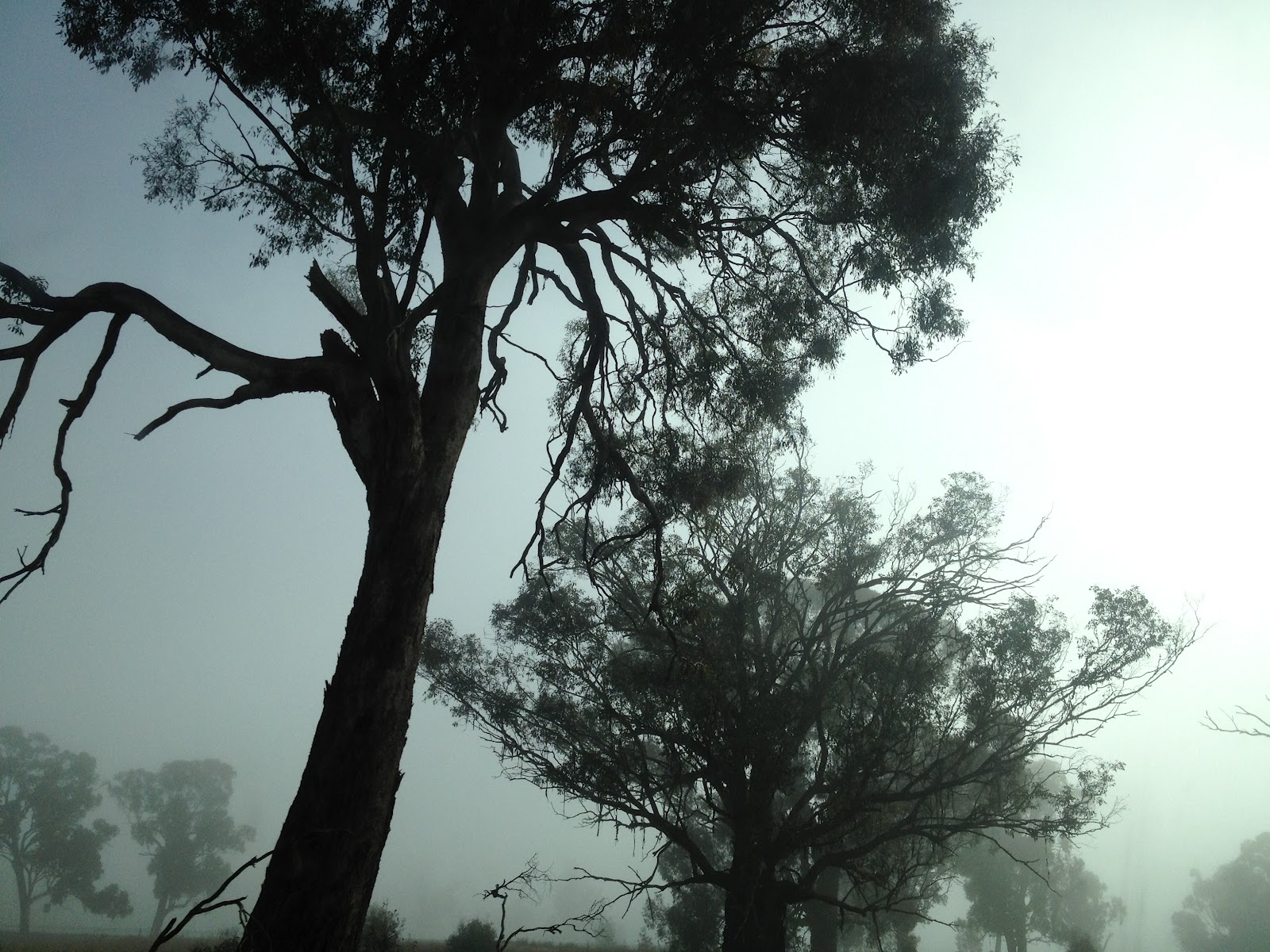
During Winter I often crave the blue sky of Summer or late Autumn. Lack of blue is like a vitamin deficiency. The day seems a little dull without the definition that high colour gives it. But Winter light is beautiful too. Deciduous trees are leafless and sculptural and let the thin sunlight through their branches. Eucalpyts and other evergreens look silver in the chalky light. And the grey, lilac and violet skies reflect off water with a drama that’s hard to remember in the Summer.

Walking through the local quarry although the air is still cold the birds are busy. They have the idea of Spring before them and work towards it. Everything seems to know where it’s going driven along by the low angle of the sun.

The land here was all under orchards until the seventies. Before that a quarry and further back - bush. Now it is park land with vestigial memory of it's earlier incarnations. Old unpruned trees drop fruit - once there were thirty different types of pear picked - prized for their sweetness and long keeping. The mudstone shelves and breaks along linear faults. Modern labour costs prohibit blasting and hauling. The quarry is once more a cliff and clean cut valley. The creek once harnessed for irrigation remembers its old water courses and ducks follow it too.I walk beside it, mesmerised by its dark surfaces.  

This morning the grass was still wet where I walked and the spiders’ webs  dewy. Hyacinths have pushed through the earth – their centres tight and bunched not really yet flowers. Under the cliffs swallows are hawking insects and in a month will begin to build  a breeding factory from mud. Soon we will be planting potatoes and picking the first broad beans. We will begin to want that squeaky green taste of uncooked peas, new lettuces, the hot crunch of radish. For now it is burnt sugar biscuits and barley tea, early evenings and cool afternoons. As the mist lifts I set out with the dogs and the smell of recent rain lingers. 

Tuesday, July 17, 2012

Dog Days of the Backyard Buddhas


We are not Buddhists but we live with three Buddhas - each of them different and each of them on a different duty.

The least fancy is our backyard Buddha. He is a tubby, bare-bellied laughing Buddha, who has the eyes of the Dalai Lama – knowing, forgiving – always faintly amused. He is only a foot high, cast concrete and there are most likely a thousand others in his exact image, who look after other backyards.

It is this very ordinariness I find endearing - a humble and humbling incarnation. He has lost some of the detail of his chin and his left hand over time. But that seems only to set him apart from others, as though cast from one mould, each incarnation seeks only to become itself, as it also works at becoming nothing.

Through the dog days of Summer he sits serenely. After weeks of rain he wears a thick green moss across his head and shoulders and it seems to me like a lesson in being still. Looking at him through the kitchen window I am reminded of the story of the saint, who held still throughout Lent, with a blackbird’s nest in his outstretched hand. St Kevin was fed berries by the blackbird and perhaps my Buddha has a similar gig. As he sits cross-legged in contemplation on his lotus, his lap might seem inviting to a bird. That’s when I think to lift him up and set him in a tree. He is safe there from being lost in the long time unmown grass. He is lifted off the ground, as though in some kind of trace-like levitation.

Our other two Buddhas are both Thai and live in the bathroom - one reclining and one walking. Recently a friend asked, why is it that our ears grow longer as we age. And without really thinking, I said, because we are better listeners now than when we were young. Now we have less to say and more to learn and less time in which to do it. But before bed as I stood cleaning my teeth I looked over at the sleeping Buddha. He has the longest ears in the world. Perhaps our earlobes hang lower as we age because we all becoming Buddha.

I had always assumed that the Buddha’s ears were long because he listened to the whole world’s worries. But today I read that his princely beginnings weighed on him and as royalty he would have worn gold ornaments in his ears. In the eighties we all wore large earrings – perhaps our earlobes are longer now as a warning to others of fashion’s follies. I stopped wearing big baubles on my ears when I had a baby. He reached for and grabbed at them, lying in my lap as fat and happy as any Buddha.

The bathroom Buddhas are both painted gold – the larger reclining one covered in mirrors. If you bend towards him you can see yourself reflected in him a hundred times over. Perhaps the idea is that, if we see ourselves in him, we will see him in ourselves also. The sleepy Buddha is cracked through from breast to thigh. He was originally a shop fitting - perhaps from a restaurant. Whether he was dropped or split in the sun I’m not sure – but he was no longer wanted. He was greasy and his gold paint was peeling when we took him home. Now he is dusted clean and spoken to but we have not mended him. A friend of my son’s got a fright seeing the Buddhas in the bathroom. She felt watched, though both have their eyes either closed or cast down. She asked him later why they sit on the side of the bath and he was not sure. Neither am I really. It seems fitting though to see the Buddha at our most naked and innocent. There is no hiding from the Buddha and no hiding from our true selves in the bathroom.

We had a fourth Buddha but I broke him. I bought him some months after Tiananmen Square, with illegal currency in a shop in Shanghai. We were allowed only to have the mostly useless FECs in the 1980’s, to be spent at designated government stores. But I was trading Australian dollars with the hotel doorman.

There were so few Buddhas to see in Shanghai at that time. We saw only the Jade Buddha in his pavilion. But he was billed as an artefact - something to see which was extraordinary because of his size. A week later walking through the French quarter I saw a ceramic Buddha. Sitting atop a pile of printed papers, he was green and white  - a smiling rather than laughing incarnation – rosy cheeked and red lipped, with ears that touched his shoulders. He was dirty - as though he had been pulled out of the earth – a fitting image for someone who sits astride a lotus. Perhaps he had been squirreled away while the Revolution raged around him. Later I was told that that was unlikely.

His grubbiness was most probably a clumsy antiquing process, applied just prior to sale. I carried him carefully home in my hand luggage wrapped in brown paper. The newspapers were still pasted up on pillars in those days in Shanghai – not commonplace enough for wrapping. He sat on the kitchen dresser for a year or two but I dropped him trying to clean some cement-like grime from his fingers. Some of the Thai and Indian Buddhas have evenly lengthed toes and fingers. Some even have slightly webbed hands. Perhaps washing the Buddha’s hands was a little presumptuous. I might have loosened the webbing and left him less capable of catching reincarnating souls.

Today when I pass the Buddha in the tree he looks a little uncomfortable. I have no lotus for him to sit upon but I cut him a cushion of moss.

Perhaps I am too much taken by graven images but this is not a lesson. I like to think that the backyard and bathroom Buddhas live with us as friends.

Sunday, July 15, 2012

Elizabeth Barrett Browning's dog


This romance like so many others in this day and age began on the internet.Love, it seems can use technology.


Six years ago we got Blue as a paddock buddy for our ailing Border Collie, Patch. The Save-a-Dog scheme, (they have a website, with pictures and a biography), billed him as a placid heeler cross. When my sister and I went to the pound to see him we looked up and down all the enclosures without finding him, not realising he was actually corgi. Thinking on it now, we were probably looking at the wrong level. Blue is really a corgi with a heelerish coat and a busy cattle dog brain. He carries himself about on stubby corgi legs well suited to the things he likes in life, like surfing. Interestingly on reading about corgis I found that they are true dwarves. A miscommunication of the genes has produced an averaged sized dog with limbs that are foreshortened. Obviously the Scottish liked this accident enough to breed true from it.


Patsy came along later. Hearing about another heeler corgi (Blorgie), dog made me curious. I went to the pound to look and came back with her. All Pat's hobbies are different from Blue's. He loves the sea - she won't get her feet wet. Blue is not interested in other animals and Pat's lives to hunt. Her Spring through Summer job is catching butterflies and skinks. I take them from her mouth when I can. Sometimes I'm too late and we have a little funeral. Pat's is not invited.Although she has the sweetest temper she is a hunter. She and I have our differences there.


Both Blue and Pats grew on me. It was not love at first sight. It has been a smouldering affair with bright moments, some tiffs, long walks, great company and a shared interest in food.With Fred it was different. I was looking for him for a long while without knowing. There was going to be no fast car or boyfriend in my mid life crisis. But I needed someone new to talk to and do things with and someone to cuddle on the couch, (apart from M). I grew up on dog stories, Lassie, Grey Friar's Bobby, Rin Tin Tin, Call of the Wild...oh I could go on. But Flush always caught my fancy. He was a lady's companion - a poet's companion. He had a book written for him by Virgina Woolf and another by Flora Merrill. There was a stage play later and then a movie. Flush was remembered for himself as much as for his owner - much like Mozart's starling. Good credentials no? A signifier if you will. Flush was a spaniel with long soft ears and a mournful gaze. He was loyal, almost prescient, an ideal escort for a walker and a reader. He was small enough to sit in Elizabeth's lap but strong enough to walk the dales. Flush was credited with curing Browning of an unnamed illness which had her confined to bed in her childhood home. I think I have been saved once or twice by dogs.


Enter Fred. He was surrendered at the Lost Dogs' Home. Not in Melbourne but in country New South Wales. I looked at his picture on their website and read his little biography: Dachshund Border Collie cross fourteen months old, needs supervision, loves people, not good with chickens or cats, desexed, answers to Fred. After two weeks of looking and longing we set off in a storm to get him. When we got Blue he was called Clive. We changed that almost immediately and he seemed not to mind. Patsy was called Patsy and it seemed to suit her. Fred I mused could be changed to Flush. The jury is still out on that.


So far this is what we know about Fred. He seems to like to sit on furniture, often I look about for him and he is sitting at the kitchen table like a person, he loves the Blorgies seemingly equally. He does not like the vacuum cleaner but will happily sit in the bathroom hand basin to have his hair blow dried. He likes to fetch a stick or a ball but will not yet relinquish them, better than this is to chase Blue and take the ball from him. He loves the car and likes to be on the front passenger's knee and watch out the window. He swallows or tries to any kind of foreign object - favourites so far are erasers, shoelaces and fleece pulled from the sheepskin in his basket. He doesn't mind being brushed but likes to help get out any tangles himself. He happily sits on my knee while I type and is there now but prefers to be walking. Whether he can balance on a boogie board or not will have to wait for Summer.

He persists in being called Fred. Perhaps after all he is not Elizabeth Barrett Browning's dog.


Other dogs in thymy dew
Tracked the hares and followed through
Sunny moor or meadow;
This dog only, crept and crept
Next a languid cheek that slept,
Sharing in the shadow.
Other dogs of loyal cheer
Bounded at the whistle clear,
Up the woodside hieing;
This dog only, watched in reach
Of a faintly uttered speech
Or a louder sighing.

from For Flush Elizabeth Barett Browning